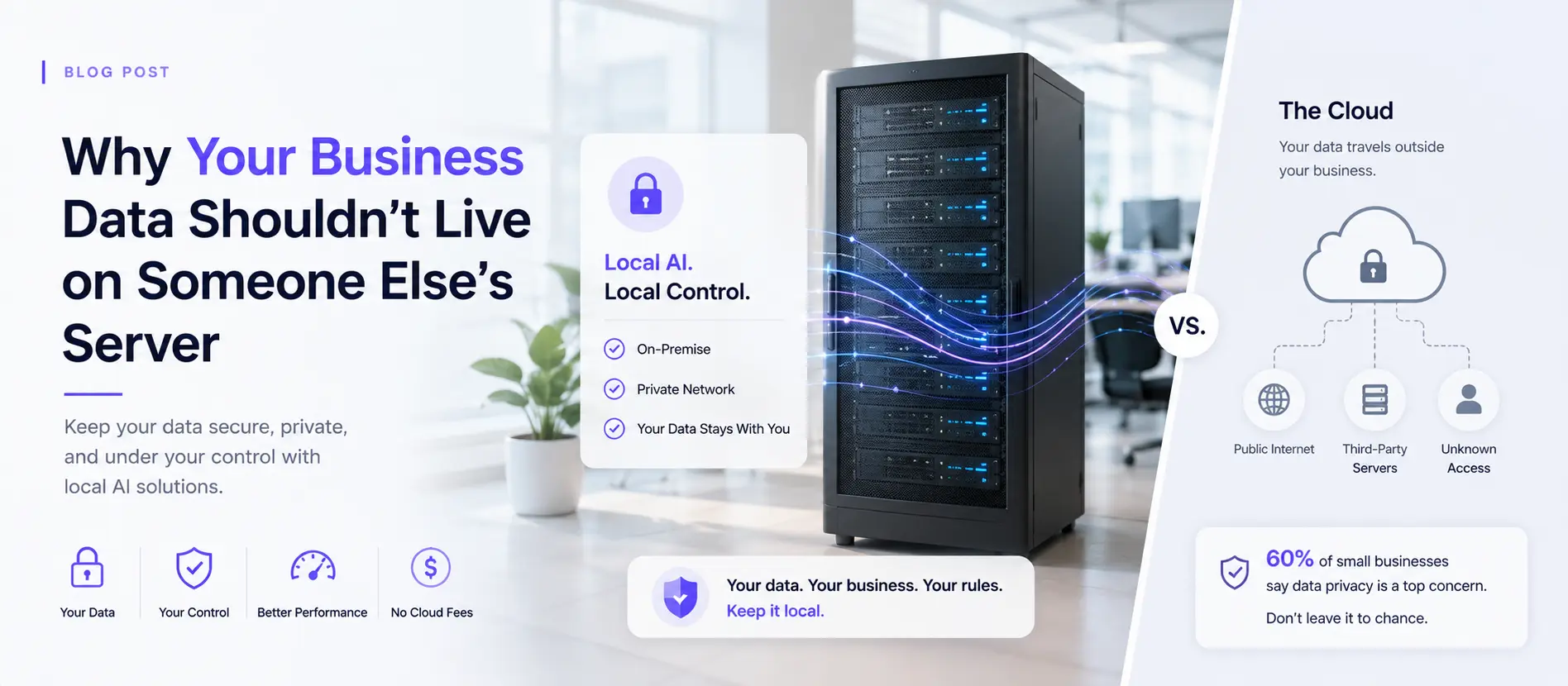
Here's something most people don't think about when they're using ChatGPT or similar AI tools for work:
The moment you paste in a client's name, a contract draft, or a sensitive email — that data travels to a server you don't own, operated by a company you didn't hire, under terms that may allow it to be used to train future models.
For a personal recipe search, that's fine. For your business? That's a real risk.
This is exactly why local LLMs (Large Language Models) are having a moment. A local LLM is essentially a private AI that runs entirely on your own hardware — your server, your computer, your network. No data leaves the building. No subscriptions to cloud AI services. No exposure.
The shift is already happening at scale: 55% of enterprise AI inference is now performed on-premises or at the edge — up from just 12% in 2023. Businesses that handle sensitive information aren't waiting to find out what happens to their data. They're keeping it in-house.
What can a local LLM actually do for a small business?
Quite a lot. Once deployed on your hardware, a local model can:
- Write and edit content — proposals, emails, social posts, product descriptions — trained on your voice and your standards
- Answer customer questions — trained on your products and services specifically, not generic internet data
- Analyze documents — contracts, invoices, reports — without sending them anywhere
- Power a smart search on your website — so visitors find answers fast
A key misconception is that local AI is somehow "lesser" than cloud AI. Models like Meta's Llama 4 and similar open-source tools running locally in 2026 are genuinely capable — and for most small business applications, they're more than enough.
The privacy math is simple
- Cloud AI: Powerful and fast to get started. But your data travels to a third-party data center, ongoing subscription costs stack up, and third-party terms apply to what you send.
- Local AI: Completely private. Runs on hardware you control. One-time setup cost. No data ever leaves your building.
For most small businesses handling customer information, professional services firms, healthcare-adjacent practices, or anyone with contracts and client files — that second option deserves a serious look.
The setup does require expertise
Choosing the right model for your use case, configuring the hardware, connecting it to your actual workflows — this isn't a weekend project. But once it's built, you've got an AI tailored to your business, running on your terms, indefinitely.
If you want a detailed comparison of how local and cloud AI stack up on capability — not just privacy — we've covered that in our post on why local LLMs often beat cloud AI for small businesses. And if the automation side is what interests you more than the privacy angle, the AI Employee post is the right starting point.
Conxion Visual Communications' AI Integrations & Local LLMs service handles the whole process — from selecting the right model for your needs to deploying it and connecting it to the rest of your systems. No vendor lock-in, no ongoing cloud subscription, no data leaving your network.
Want to explore private AI for your business? Let's have a real conversation. →