Not long ago, getting found online meant one thing: rank on page one of Google. Shoot for those blue links. Get the clicks. Done.
That's still true — but it's only half the story now.
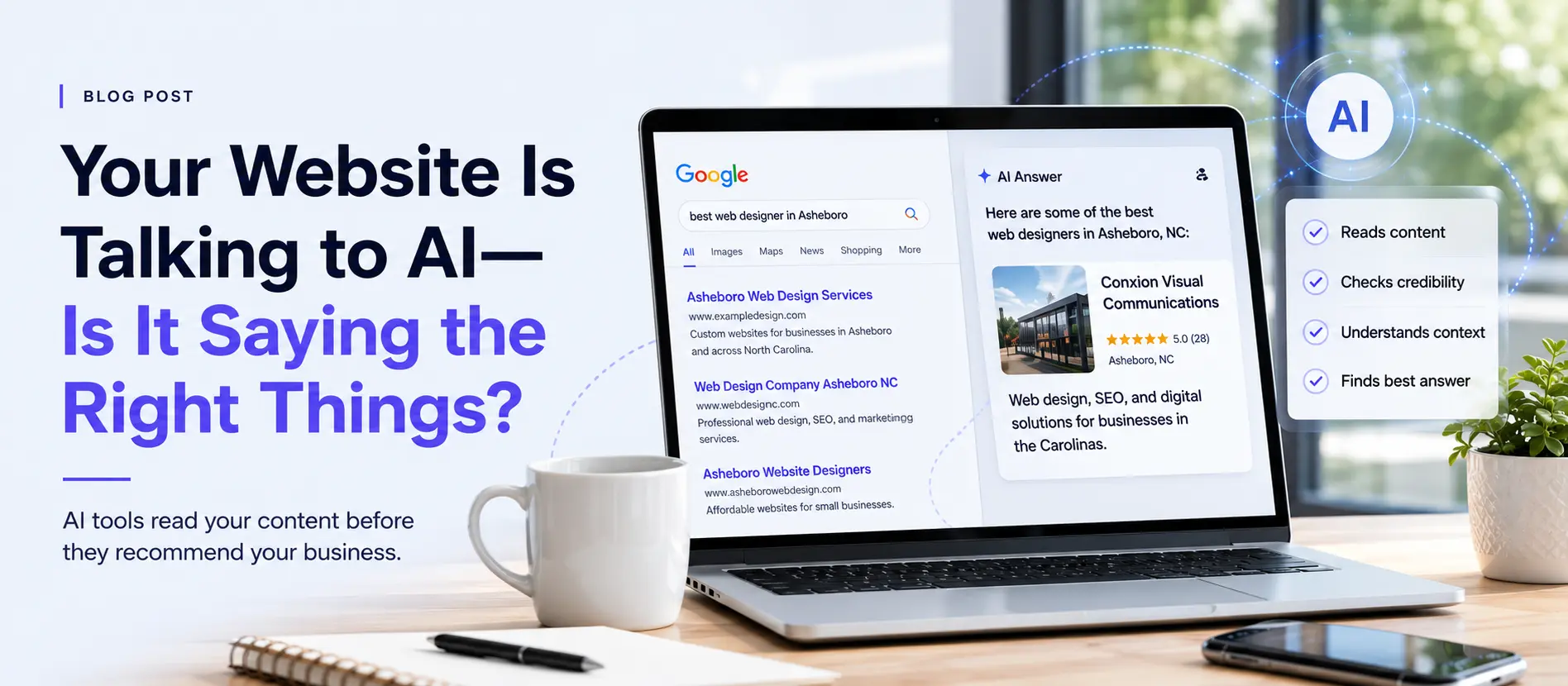
In 2026, a growing number of people don't type into Google at all. They ask ChatGPT, Perplexity, or their phone's AI assistant: "Who's the best web designer in Greensboro?" or "What's a good ecommerce platform for a small boutique?" The AI answers — and it doesn't always include you, even if you rank perfectly in classic search.
This shift has a name: GEO (Generative Engine Optimization) and AEO (Answer Engine Optimization). Fancy terms, simple idea — AI tools are now gatekeepers of discovery, and they have different rules than traditional search engines.
You can rank on page 1 of Google and still not be named in an AI answer. These are two different games — and right now, most small businesses are only playing one of them.
What does an AI actually look for?
Think of it like a really thorough fact-checker. When an AI reads your website to decide whether to recommend you, it's evaluating four things:
- Clarity — Does your page clearly say what you do, who you serve, and where you are? Vague language ("we help businesses succeed") gets skipped. Concrete descriptions ("we build Shopify stores for retail boutiques in the Carolinas") get picked up.
- Credibility — Do other reputable websites mention you? Do you have reviews? Citations and references matter to AI the same way they matter to a journalist verifying a source.
- Structure — Are your headings logical? Is your content organized so a machine can follow the argument from start to finish?
- Specificity — AI systems favor businesses that own a clear niche over generalists who claim to do everything. The more precisely you describe your work and your customers, the more often you'll be named.
The businesses getting named inside AI answers in 2026 are the ones with clean, honest, direct web content — not necessarily the ones with the fanciest designs.
The good news: most of these fixes aren't a full redesign
Sometimes it's as simple as rewriting your homepage's first paragraph so it leads with what you actually do and who you serve. Sometimes it's adding a proper FAQ section so AI has clear, quotable answers to pull from. Sometimes it's making sure your Google Business Profile is complete and current — because AI assistants often pull location data from there.
None of this requires a new website. It requires a clear-eyed look at what your current site is actually communicating — and whether that matches what AI systems are looking for when someone asks about businesses like yours.
Conxion Visual Communications' Growth & Optimization service covers exactly this — SEO tuning, AEO structuring, and GEO positioning so your business shows up in all the places people are looking, not just the ones that existed five years ago. If you want a deeper look at how AI-powered tools can work for your business specifically, our AI Integrations service takes it further.
Reach out — we'll take a look and give you a straight answer.
Think your website might be invisible to AI search? Let's find out. →